Introduction – Why Modern Flexo Needs Image Recognition
In flexographic printing, plate mounting has historically been a manual, time-consuming step. Misaligned plates lead to registration issues, wasted substrate and higher costs. Today, image recognition – a branch of computer vision – enables automatic flexo plate mounting. By analysing registration marks and microdots, advanced systems align plates with micrometre precision. This article explains how image recognition works in flexo, why it matters and how AV Flexologic applies it in its latest plate-mounting machines.
What Is Image Recognition?
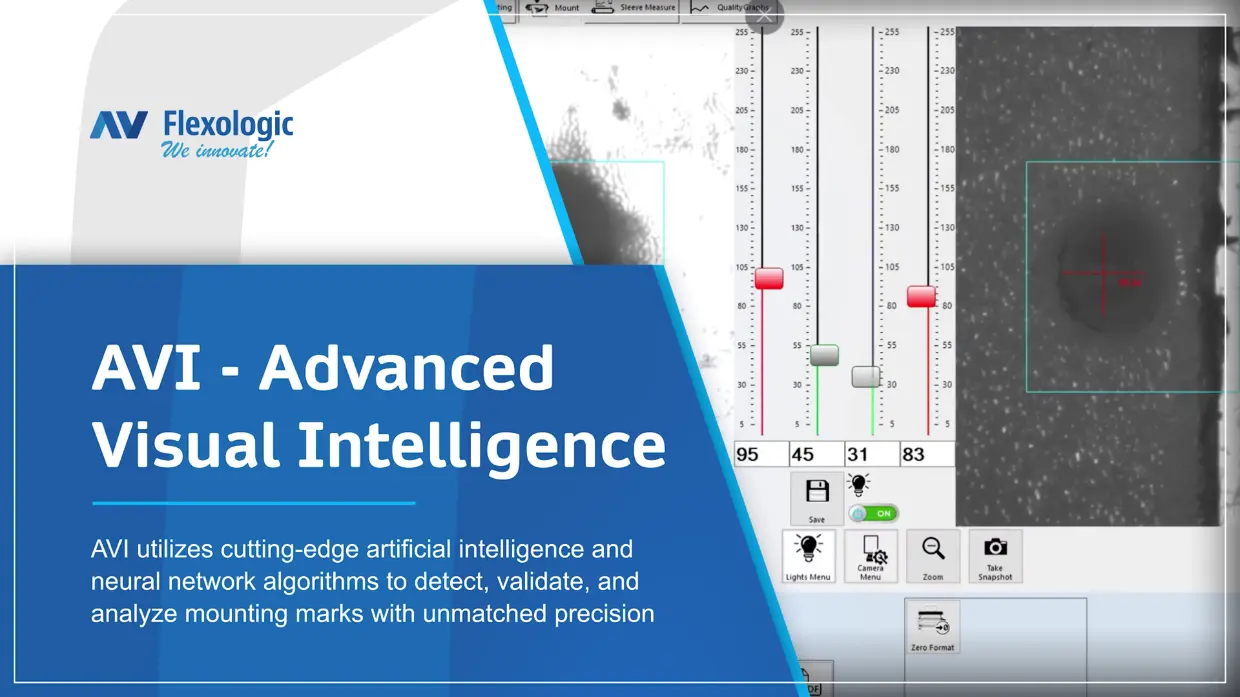
Image recognition is a subset of computer vision that allows software to identify and interpret visual patterns. In flexography, cameras capture the plate’s registration marks or fiducials. The machine’s software recognizes these marks, compares them with target positions and calculates any necessary adjustments. Unlike simple optical sensors, image-recognition algorithms can process high-resolution images and compensate for slight distortions or lighting variations.
How Image Recognition Works in Plate Mounting
Automated plate mounters follow a repeatable workflow:
- Capture the mounting area – High-resolution cameras record live video of the plate and sleeve.
- Detect registration marks – The software identifies predefined markers (microdots, crosshairs or other fiducials) on the photopolymer plate.
- Compare to target positions – The detected positions are measured against the ideal mounting coordinates stored in the system.
- Adjust in real time – Robotic actuators move the plate or sleeve to correct any deviation. Positioning accuracy on advanced systems is typically ±5 microns.
- Apply the plate – Once aligned, the plate is pressed onto the sleeve via motorized rollers or vacuum systems, ensuring an even, bubble-free bond.
The entire process takes seconds, eliminates operator guesswork and delivers micrometer-level accuracy. By automating both detection and alignment, image-recognition systems reduce variability and speed up changeovers.
Benefits of Image Recognition in Flexo
Incorporating image recognition into your plate-mounting workflow yields several advantages:
- Precision & repeatability – Automated alignment achieves ±5 micron accuracy, far beyond manual capabilities. Every mount is consistent, regardless of shift or operator.
- Speed & productivity – Aligning and mounting plates takes seconds instead of minutes. Faster setups increase press uptime and throughput.
- Reduced training time – New operators can become productive quickly because the machine guides most of the process. There’s less reliance on specialist skills.
- Lower waste & rework – Properly mounted plates minimise registration errors, print defects and the need for remounting.
- Data-driven quality control – Modern systems log alignment data, enabling proactive maintenance and quality tracking.
These benefits translate to cost savings, improved print quality and happier customers. In highly competitive packaging markets, adopting technologies that increase accuracy and reduce waste gives converters an edge.
AV Flexologic’s Image-Recognition Solutions
AV Flexologic has been pioneering automated plate mounting for more than two decades. Our latest systems, including the SAMM 3.0 automatic plate mounting machine and FAMM 3.0 automatic mounting machine, leverage cutting-edge image-recognition technology:
- Multiple cameras capture both plate fiducials and sleeve edges to ensure comprehensive alignment.
- Advanced vision software calculates adjustments in real time and compensates for plate or sleeve tolerances.
- Robotic actuators move the plate with high precision, eliminating manual intervention.
These features enable converters around the world to maintain consistent quality across multiple shifts and locations. By minimizing operator dependency, printers can focus on productivity and quality rather than manual alignment.
Conclusion – A Foundation for Modern Flexo Workflows
Image-recognition technology has transformed plate mounting from a manual art into a reliable, data-driven process. By using cameras and sophisticated software to detect registration marks, automated plate mounters align plates with micron accuracy in seconds. The result is faster setups, fewer errors and consistent print quality – benefits that directly affect a converter’s bottom line.
As the flexographic industry embraces automation, systems like AV Flexologic’s SAMM 3.0 and FAMM 3.0 demonstrate how image recognition delivers real-world value. For converters seeking to improve efficiency and quality, adopting automated plate-mounting solutions is an investment that pays off quickly.
Curious how automated plate mounting can improve your production? Contact us for a personalised demo or explore our range of automatic plate mounting machines to see which solution fits your needs.
About the Author
Martijn Otten
Managing Director
Martijn Otten is the Managing Director of AV Flexologic and Tech Sleeves, leading companies in the flexographic printing industry. He holds an MSc in Mechanical Engineering and has over 20 years of experience in the field. Martijn's technical expertise and commercial drive have introduced significant advancements in automation technology for flexographic printing, winning several leading technical innovation awards such as the FTA Innovation Award (2x) and the FIA, EFTA, and FlexoTech Innovation Awards. A firm believer of Lean methodologies, Martijn continuously seeks to improve efficiency and eliminate waste in manufacturing processes, whether this is in-house at AV Flexologic or at customers process. His contributions to the industry extend beyond his leadership at AV Flexologic, as he regularly shares his insights on the future of automation in flexographic printing in various publications.