Introduction: Why Sleeve Storage Is More Important Than You Think
In flexographic printing, sleeves are a precision component—just like plates, anilox rolls, or mandrels. And just like any precision tool, improper storage can quickly lead to damage, dimensional distortion, or quality issues on press.
Storing sleeves correctly extends their lifespan, maintains roundness and diameter tolerances, and prevents press issues like bounce, registration errors, or misalignment. This guide walks through the fundamentals of proper sleeve storage and why it’s essential for consistent flexo performance.
The Risks of Poor Storage
Improper sleeve storage can lead to:
- Deformation: Laying sleeves flat or stacking them can cause ovality or flat spots
- Surface damage: Scratches, dents, or edge chips from contact with hard surfaces
- TIR deviation: Long-term sagging or warping affects roundness and fit
- Contamination: Dust, ink, or grease residues that compromise mounting or printing
- Increased bounce: Sleeves with high/low spots cause dynamic instability on press
Once a sleeve is distorted, it can’t be corrected—it must be replaced, often at high cost.
Storage Conditions: Environment Matters
Sleeves should be stored in clean, dry, temperature-stable areas.
Key environmental guidelines:
Temperature
Avoid heat sources or cold zones. Store at 18–25°C (64–77°F).
Humidity
Should remain below 60% to prevent moisture penetration.
UV exposure
Avoid direct sunlight which can degrade materials over time.
Handling
Always transport sleeves using designated carts or lift systems—never by rolling or dragging.
These rules protect not only the sleeve body but the internal structure and adhesives
Vertical vs. Horizontal Storage
Vertical storage is the industry standard since some sources claim that horizontal storage leads to distortion. If vertical storage is used:
- Ensure sleeves are supported on the inner core, not the sleeve body
- Use soft resting surfaces to avoid edge chipping
- Avoid leaning or tilting sleeves at an angle
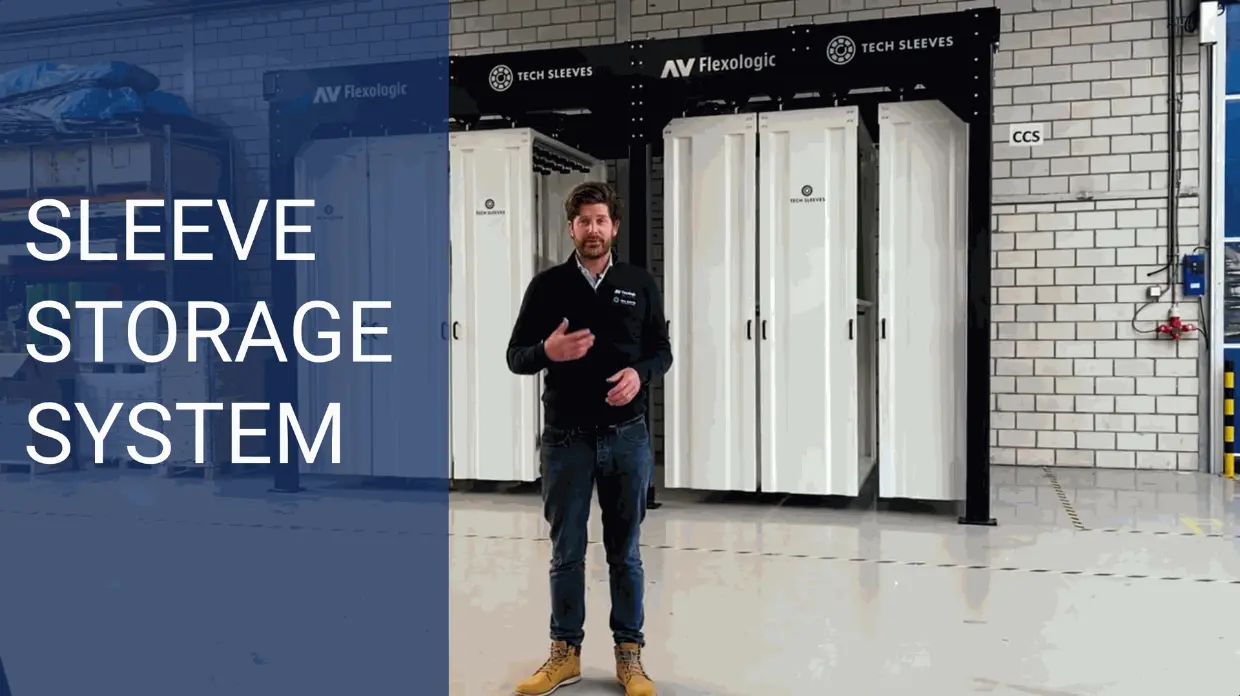
AV Flexologic’s vertical sleeve racks are designed with safe core support and customizable layouts for various sleeve types.
Best Practices for Sleeve Organization
- Label sleeves with job ID, repeat size, and storage location
- Group sleeves by press, repeat size, or customer
- Use barcode or RFID systems for traceability
- Log inspections to monitor damage or tolerance shifts
- Train all staff on sleeve handling SOPs to reduce risk
Organized storage boosts efficiency and protects your sleeve investment.
Automation in Sleeve Storage
For high-volume operations, manual storage reaches its limit. AV Flexologic partnered with Enviroxi 2.0 on a robotic sleeve storage system, which provides:
- Automated vertical storage and retrieval
- Integrated job data linkage (via ERP or AVManager)
- Minimal human handling = less damage risk
- Precise sleeve location tracking and usage logs
Automation supports lean production and eliminates waste caused by misplacement, damage, or search time.
Conclusion: Protect Quality from the Ground Up
Flexo sleeves are essential for print quality—and proper storage is essential for sleeve health. Whether you're storing a few dozen sleeves or several thousand, the same rules apply: keep them upright, protected, clean, and accessible.
With best practices in place—and the right storage systems—printers can preserve sleeve tolerances, reduce rework, and maintain consistency across jobs. It’s not just about where you put the sleeves—it’s about protecting performance on press.
About the Author

Martijn Otten
Managing Director
Martijn Otten is the Managing Director of AV Flexologic and Tech Sleeves, leading companies in the flexographic printing industry. He holds an MSc in Mechanical Engineering and has over 20 years of experience in the field. Martijn's technical expertise and commercial drive have introduced significant advancements in automation technology for flexographic printing, winning several leading technical innovation awards such as the FTA Innovation Award (2x) and the FIA, EFTA, and FlexoTech Innovation Awards. A firm believer of Lean methodologies, Martijn continuously seeks to improve efficiency and eliminate waste in manufacturing processes, whether this is in-house at AV Flexologic or at customers process. His contributions to the industry extend beyond his leadership at AV Flexologic, as he regularly shares his insights on the future of automation in flexographic printing in various publications.